


This release is the one I have wanted to ship for a long time. MantisBase can now send email, and with that comes the set of features most backends need before they can be called production-ready: email verification, one-time-code sign-in, and password reset. Alongside it, the prebuilt binaries now cover macOS and Windows ARM, and the first stubs for Python and Node.js bindings are in the tree.
If you just want the short version: nothing breaks for existing REST clients. Password login, tokens, and your schemas behave exactly as before. Every new auth check is off until an admin turns it on.
Outbound mail comes first.
Everything in the auth work below depends on one thing: the server being able to send a message. MantisBase now ships with an SMTP mailer.
Settings live in an smtp object with host, port (default 587), user, password, from, and tls (default true). An empty host disables sending, so a fresh install stays quiet until you decide otherwise. You can configure it in three places:
The Settings page in the admin dashboard at
/mbPATCH /api/v1/sys/settings/configA startup script, with
app.settings().set("smtp", ...)
Changes apply immediately, with no restart. Port 465 with tls: true uses implicit TLS; any other port uses STARTTLS; tls: false is cleartext, which is fine for a local test server and nowhere else.
A small detail I care about: when you read the settings back, a stored password comes back as "********". If you send that mask or leave password out of the request, the stored value is kept. Sending an empty string clears it. That means you can round-trip the settings object from a form without ever leaking or accidentally wiping the secret.
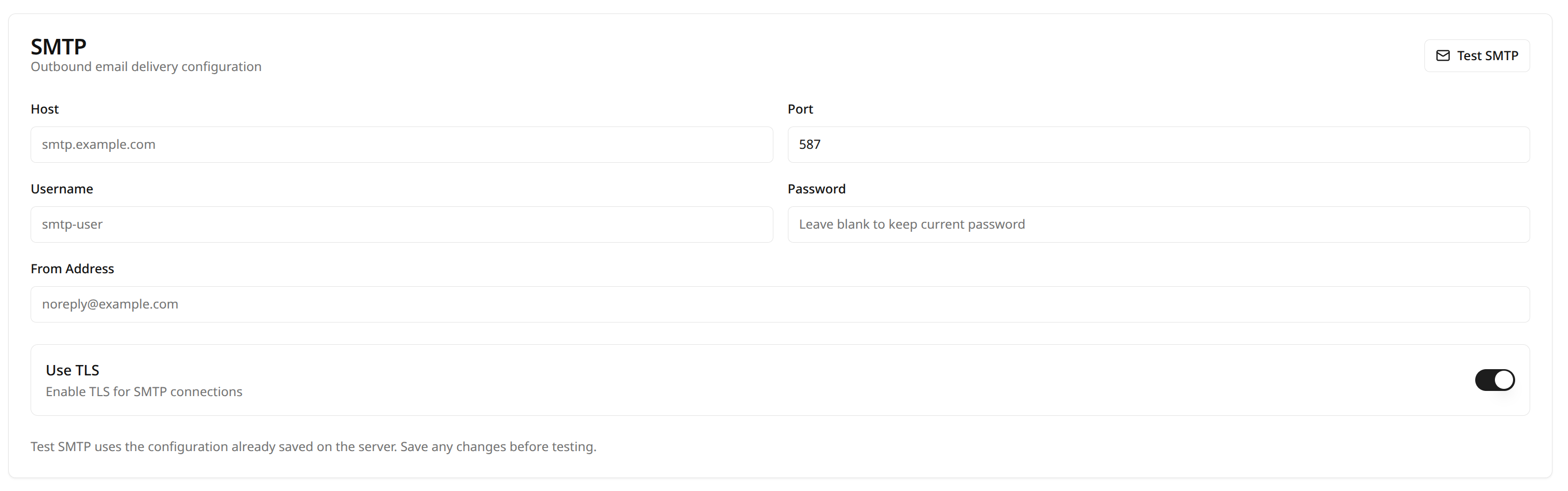
SMTP settings on the admin dashboard
To check your setup, call POST /api/v1/sys/settings/smtp/test with { "email": "you@example.com" }. It needs admin auth, and the same recipient is limited to three messages per hour, so it cannot be turned into a mail cannon.
Email verification
Auth tables now get a system field, email_verified (boolean, default false), added automatically on startup. Existing rows start out unverified, and that does not block anyone from logging in unless you ask it to. Admin accounts in mb_admins do not have the field.
With SMTP configured, registration emails a link of the form {siteDomain}/api/v1/auth/<entity>/verify-email?token=.... The link lasts 24 hours and works once. You can confirm through the link itself, which renders a small HTML page, or from a client with POST /api/v1/auth/<entity>/verify-email and a { "token" } body.
A few design choices worth calling out:
Clients cannot set the flag. Only an admin can, with
PATCH /api/v1/entities/<entity>/<id>.Changing the account email clears it. A verified address should stay tied to the address that was verified.
Resend does not leak.
POST /api/v1/auth/<entity>/verify-email/requestalways responds with{ "sent": true }, even when the address is unknown or already verified. No message is sent in those cases, so the endpoint cannot be used to find out who has an account.OAuth counts. If the provider asserts
email_verified, MantisBase marks the address verified for you.
To make verification mandatory, set auth.requireEmailVerification to true. Password, OTP, and OAuth logins then return 403 Verify your email before signing in. until the flag is set. It defaults to false, and sessions that already exist stay valid.
One-time email sign-in
Some apps do not want passwords at all. Two endpoints cover that case:
POST /api/v1/auth/<entity>/otp/requestemails a code.POST /api/v1/auth/<entity>/otp/loginexchanges the code for a session.
OTP is off until an admin sets auth.otp to true. While disabled it returns 403, and it returns 400 if SMTP is not configured, so a misconfiguration is easy to tell apart from a policy decision.
Per-method login switches
OTP is one of three new switches on each auth entity: auth.password (default on), auth.otp (default off), and auth.oauth (default off). You change them with an admin PATCH /api/v1/schemas/<name>, and anyone can read them without a token at GET /api/v1/auth/<entity>/methods, which makes it simple for a front end to render only the sign-in options that are actually enabled.
Turning a method off leaves sessions that are already signed in alone. It closes the door for new logins; it does not throw people out.
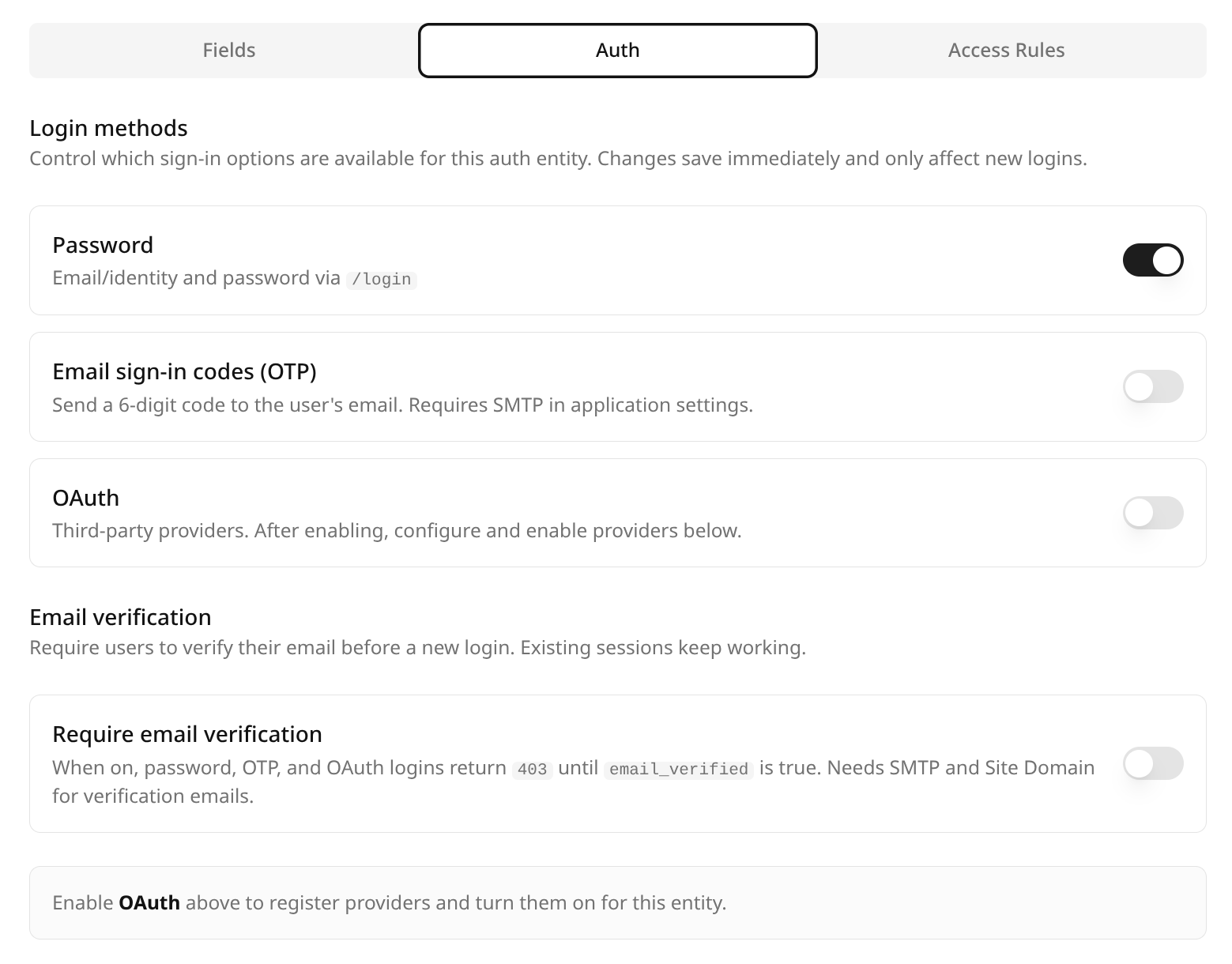
Login method switches and the email verification toggle on the admin dashboard.
Password reset
POST /api/v1/auth/<entity>/password-reset/request emails a link to {siteDomain}/api/v1/auth/<entity>/password-reset?token=.... It lasts one hour and works once. In a browser the link shows a form; from a client you can POST { "token", "password" } directly.
Passwords must be at least 8 characters with no whitespace. A successful reset invalidates every session on that account, which is the safe default if the reset was triggered because someone else had access. As with verification, unknown addresses still return { "sent": true } and send nothing. SMTP and siteDomain must both be set.

Context menu for password reset and email verification actions on the admin dashboard
Python and Node.js bindings: stubs only
The Python and Node.js bindings are not usable yet. This release puts the stubs in the tree, but they do not build on CI yet and nothing is published to PyPI or npm, so please do not try pip install mantisbase or npm install mantisbase for now.
The goal is to let you start MantisBase from your host language and work with the app, router, request, response, and database query from there. The stubs are the groundwork for that.
Once CI builds pass, the plan is for tag builds to publish Python wheels (CPython 3.9 to 3.13, across Linux, Windows, and macOS) and Node prebuilds, so installation will not need a compiler. I will announce it properly when it is ready.
macOS and Windows ARM
Server binaries and C++ dev packages now ship for macOS (named darwin in the release assets) and Windows ARM, next to the existing Linux and Windows x64 builds. Getting there meant fixing an endian check, std::atomic handling on Windows ARM, the ordering of [[nodiscard]] and MANTISBASE_API, libpq and uuid linkage, and some Clang link errors in SOCI. None of it is glamorous, and all of it is why a clone now builds on more machines than before.
On the build side, dependencies are vendored in the tree, so you no longer need --recurse-submodules when you clone.
Breaking change for C++ embedders: the Mb prefix
If you embed MantisBase from C++, this section is for you. Public types now carry an Mb prefix to avoid collisions with your own code. The project name is unchanged, and log and module name strings stay without the prefix.
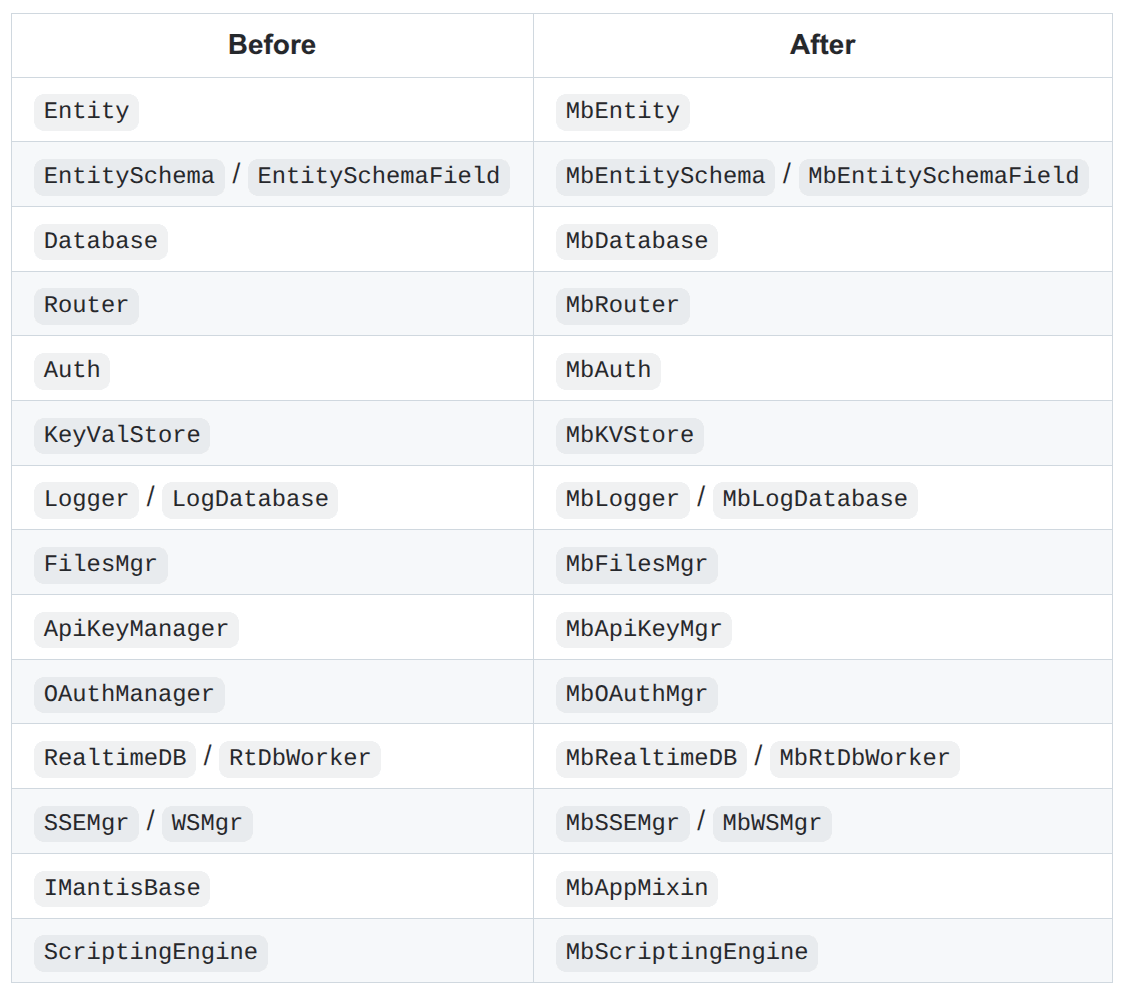
HTTP body handling also moved onto the request: multipart parsing, parseFormDataToEntity(), and writeFiles() now live there, and the separate content-reader type and the old httplib request path are gone. Entity‘s copy constructor takes a const reference. Rebuild against the new headers and fix the compiler errors; the renames are mechanical.
Smaller fixes
/mantisbase.svgand/favicon.icono longer return 404 and resolve to the admin assets (#148).Admin static files now escape slugs in paths.
The bundled admin dashboard is updated to v0.4.2.
Linux CI no longer runs the logger test that was failing on that platform.
Upgrading
REST clients. Nothing changes until you opt in. Before enabling verification or reset links, set siteDomain and configure SMTP.
Auth tables. Startup adds email_verified to auth entities created before this release. Existing rows are unverified, which does not block login while requireEmailVerification is false.
C++ embedders. Update the renamed types and call form parsing on the request.
From source. Drop --recurse-submodules from your clone and update commands.
Try it.
Test it out on the playground at https://demo.mantisbase.com, grab the release from github.com/allankoechke/mantisbase and read the docs at mantisbase.com. If you hit a rough edge, open an issue; this release touched a lot of surface area, and I would rather hear about it early.