

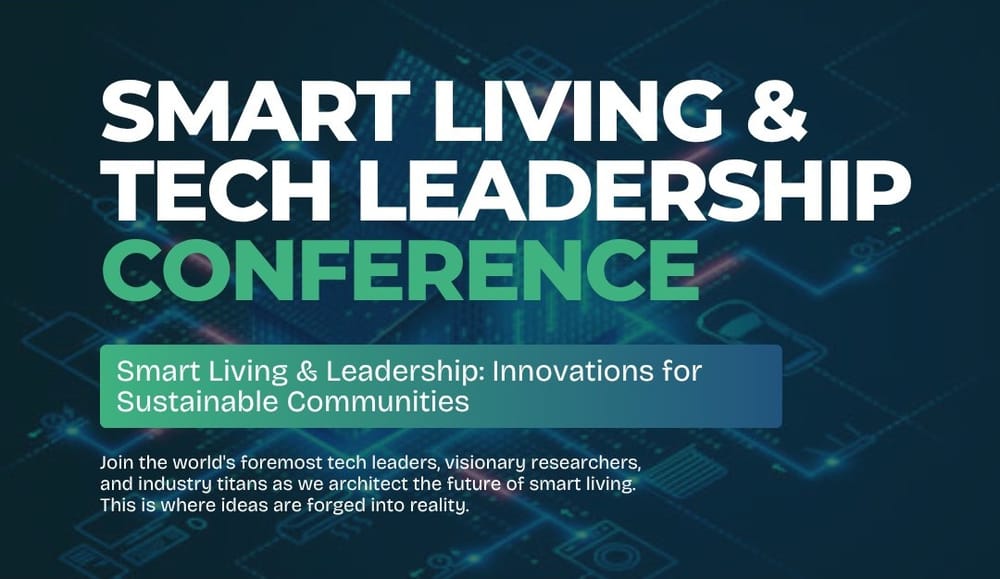
Smart Living & Leadership: Designing for Tomorrow
The second edition of the Smart Living & Tech Leadership Conference 2025 ran for two days, with intense, future-focused dialogue. Day one set the foundation — sustainability, leadership, and the evolving role of cities in shaping human experience. Talks centred on energy management, mobility systems, and the ethics of digital transformation.
Day two shifted toward design, technology, and AI, unpacking how digital tools turn ideas into smarter, more liveable environments.
The Core Idea
Smart living isn’t about gadgets. It’s about intentional design. Every decision — spatial, structural, or digital — shapes how we live, move, and connect. Design is the link between people, data, and sustainability.
— Steve Jobs
Steve Jobs was a visionary who foretold of what it became of today, a fusion of design and functionality. A move toward designing for use rather than designing for aesthetics alone.
My Session: Smart Living by Design
I presented “Smart Living by Design: Evolving from Digital Tools to AI Decisions.” The session traced design’s evolution—from manual drafting to data-driven modelling and now to intelligent, AI-augmented systems.
- Digital tools like Revit, Inventor, 3ds Max, and Maya redefined collaboration and precision.
- AI now extends creativity — generating forms, predicting outcomes, and guiding sustainable choices.
- Projects like Bernini show how AI-driven 3D generation can reduce waste and optimise performance.
- Digital twins enable continuous feedback loops between the real and virtual worlds, making smart cities adaptive by design.
The key takeaway: AI doesn’t replace creativity — it amplifies it. The future designer leads with intent, while AI accelerates exploration and insight.
Conversations That Followed
Post-session discussions were rich. People wanted to know how data models support interoperability across industries and where the limits of AI automation should be drawn. Others shared case studies on generative layouts for housing, mobility planning, and carbon analysis.
Outside the panels, the networking felt natural. Designers, engineers, urban planners, and educators connected over one shared vision — building systems that think with us, not for us.
Closing Thought
The conference reinforced a simple truth: design is leadership. Tools evolve, but human intention drives change. If we design with purpose — aligning creativity, technology, and sustainability — smart living becomes not an idea, but a lived reality.
Join the conversation!
#Design isn’t only about how it looks — it’s how it works.
— Allan K. Koech, HSC (@allankoechke) November 6, 2025
At the Smart Living Conf, we explored how #AI is becoming a design partner. From #AEC to #MFG and M&E, AI helps us move ideas to reality; optimizing layouts, improving precision, and driving sustainable innovation. pic.twitter.com/LO5NcE2wfk